Minimal Pictorial: a wall of photographs
./blog.sh v1.11 — part 11 of 12
Minimal assumes that a post begins with words: a title, three lines of an opening, and a picture, if there is one, only inside the post. A photoblog has it the other way round. The photograph is the post and the words are its caption, sometimes only a date. Minimal Pictorial is the variant for such blogs. In it, the page is a wall of photographs.
This text is a guide, not a story: what is how and why, with the numbers read out of the file. Whatever is not here is the same as in Minimal and is in its guide. The pictures are from a test blog in the engine's default palette. If you would rather not read all of it, there are ten questions at the end.
One sentence
Minimal Pictorial is a wall of photographs: the picture is the first thing you see, and the words are a caption under it. It is a skin for blogs on ./blog.sh, of the Minimal family, and it takes its colours from the blog it runs on. From blog.sh 1.11 it comes with the engine: site.skin: minimal-pictorial in config/site.yml puts it on; layout.lead_card: true and a page of nine or twelve posts suit it, and ./style.sh sets the skin and the lead card too. This guide describes it as of 1.11.1.
Principles
Five sentences in which it differs from Minimal. Minimal's own five still hold.
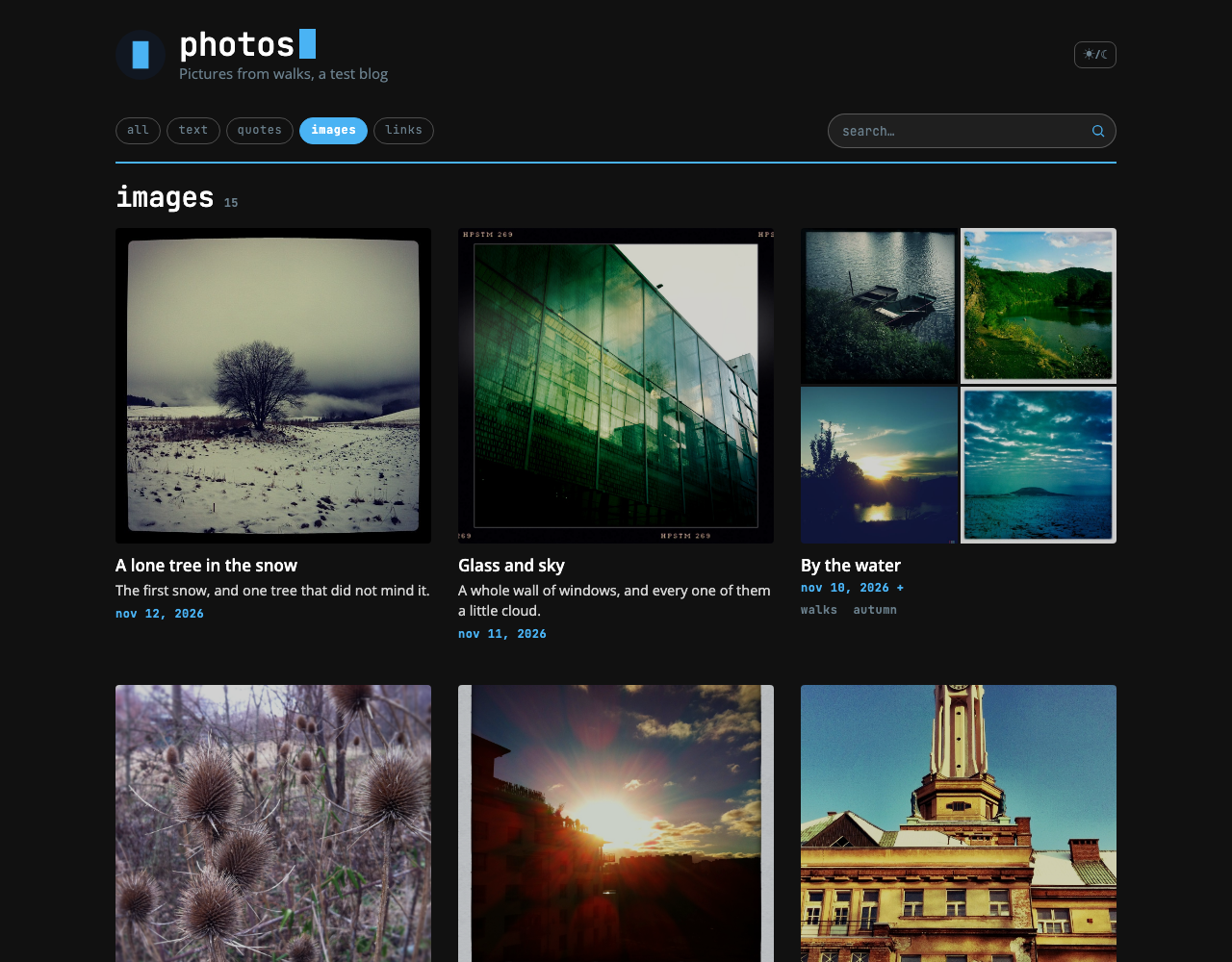
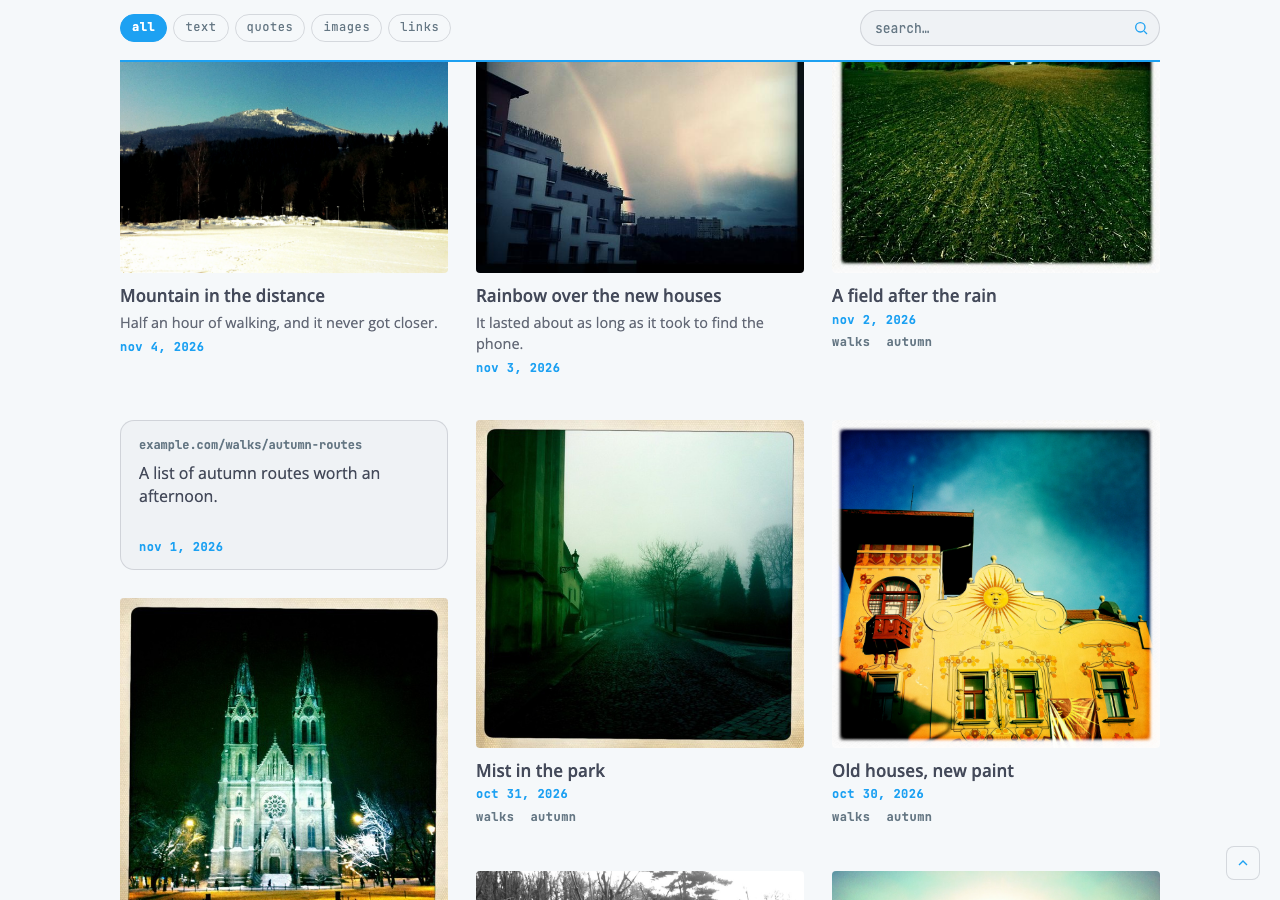
- A listing is a wall, not rows. Three photographs across on a computer, two on a tablet, one on a phone.
- There is nothing round a picture. No frame, no rule, no card; only a corner of 4 px.
- On the wall a photograph is a square; in its post it is whole. The wall crops; a post does not, unless it has a hero.
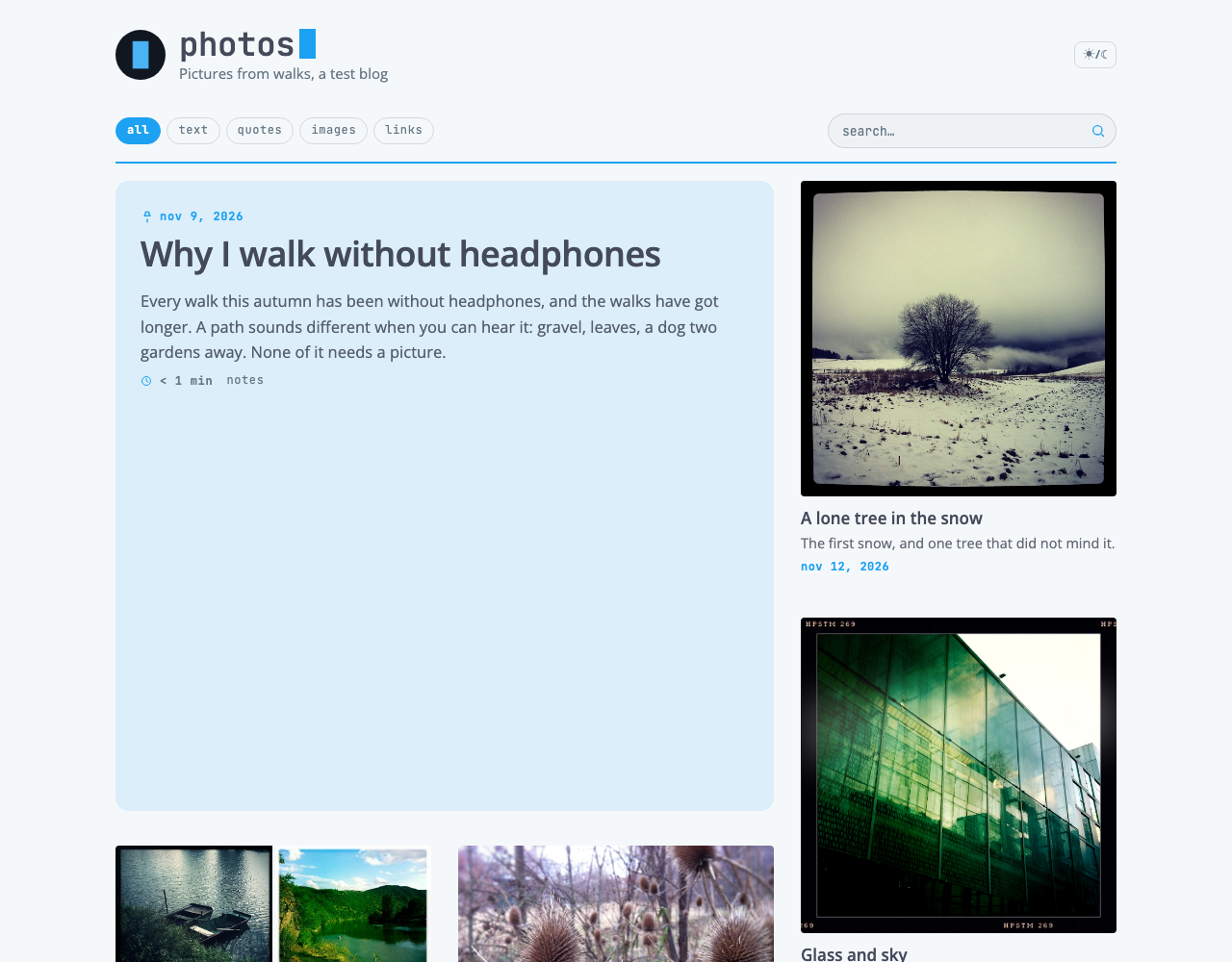
- A post that does not open with a photograph is a tile of words. A card half as tall, which shares a photograph's height with its neighbour.
- What stood beside stands under. The width Minimal gives to its sidebar has gone to the wall.
Colours
Unchanged. Paper, ink, muted and the accent are read from the blog's colors:; the rule, the plate and the lead's ground are mixed from them in the same proportions as in Minimal. Pictorial adds no tone and no colour.
Type
Unchanged: the engine's two faces and three voices. Only the sizes on the wall differ, where there is less room than in a row.
A tile's title is Open Sans, 17 px on a photograph, 17 to 20 px on a tile of words by the width of the window, weight 600, in the ink. The caption under it is 14.5 px on two lines. The date is the engine's voice: JetBrains Mono, 12 px, bold, in the accent.
A post's text is 17 px with a leading of 1.7, in a column of 700 px.
Shapes and marks
The pill, the key, the card and the filled button are Minimal's. Pictorial adds the tile, in three forms.
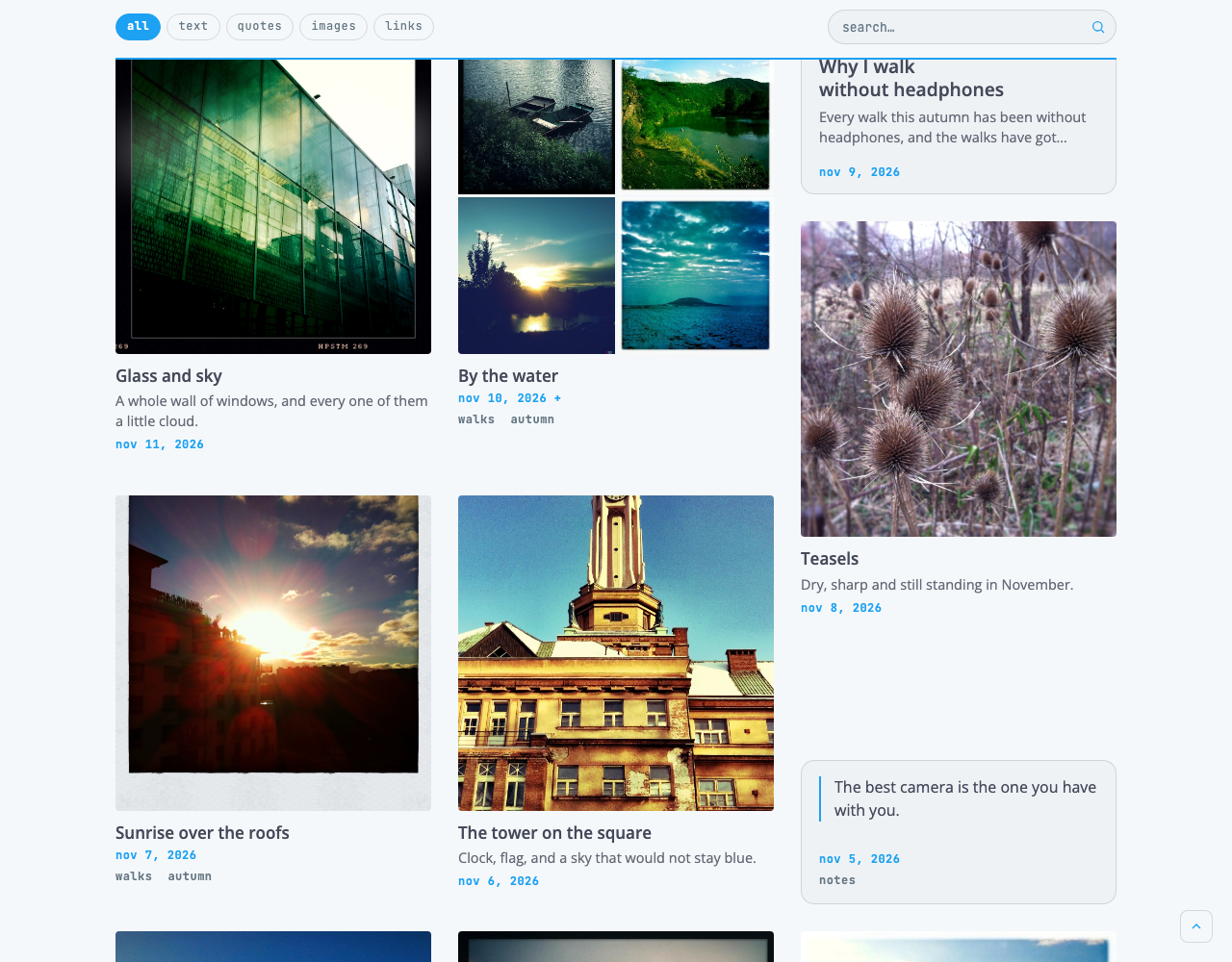
A tile with a photograph is a square with a corner of 4 px, with no rule and no ground. Under it the title or, where the post has none, its first words; two lines of caption; and the date. A video is a tile like a photograph.
A gallery's tile is a mosaic of its first pictures inside the same square, 3 px apart: four in two rows, three as one tall beside two, two side by side. The lead keeps its one picture.
A tile of words is a post whose card does not open with a picture: Minimal's card, with its plate, hairline and corner of 14 px. The words begin at the top and the date stands at the foot, so the tiles of one row share an upper and a lower edge however much each of them says. A post with no title leads with its own first words (16 px, up to five lines); a quotation with what was said (four lines, with a 2 px rule in the accent on the left).
A link's tile with no title of its own opens with the address it points to: in the small monospace, muted, on one line and without its protocol. https:// says nothing, and on a line 290 px wide it takes a fifth of the room.
Two small marks belong to the wall:
- A
+after the date says there is more behind the photograph: a gallery, or a post too long for its card. - Tags are worn by a tile only when it has no caption. They are quiet words on one line, and they are there so that a tile with tags is not a photograph and a date alone.
Rules and air
The page is 1080 px wide as in Minimal, and the head, the menu and the foot stand where they stand in every skin of the family. But the sidebar is not beside the content: it stands under it, three cards across, 56 px under the end of the wall and under a hairline.
The gap between tiles is 28 px both ways. At full width a tile comes out at 328 px.
The wall is laid in half rows. A photograph takes two, a tile of words one, and the grid fills what would otherwise be left empty: beside a photograph two tiles of words stand one above the other and share its height, instead of one tile and a hole. This has one consequence. To fill a hole the grid may take a tile of words a place early, so a wall that mixes photographs and words is not strictly in order of date from left to right. A wall of photographs is.
Under a lead with a photograph there is 20 px more air than between two rows, under one without 8 px.
Front page and listing
Every listing is a wall: the front page, a tag's page, a listing by kind of post, and a series.
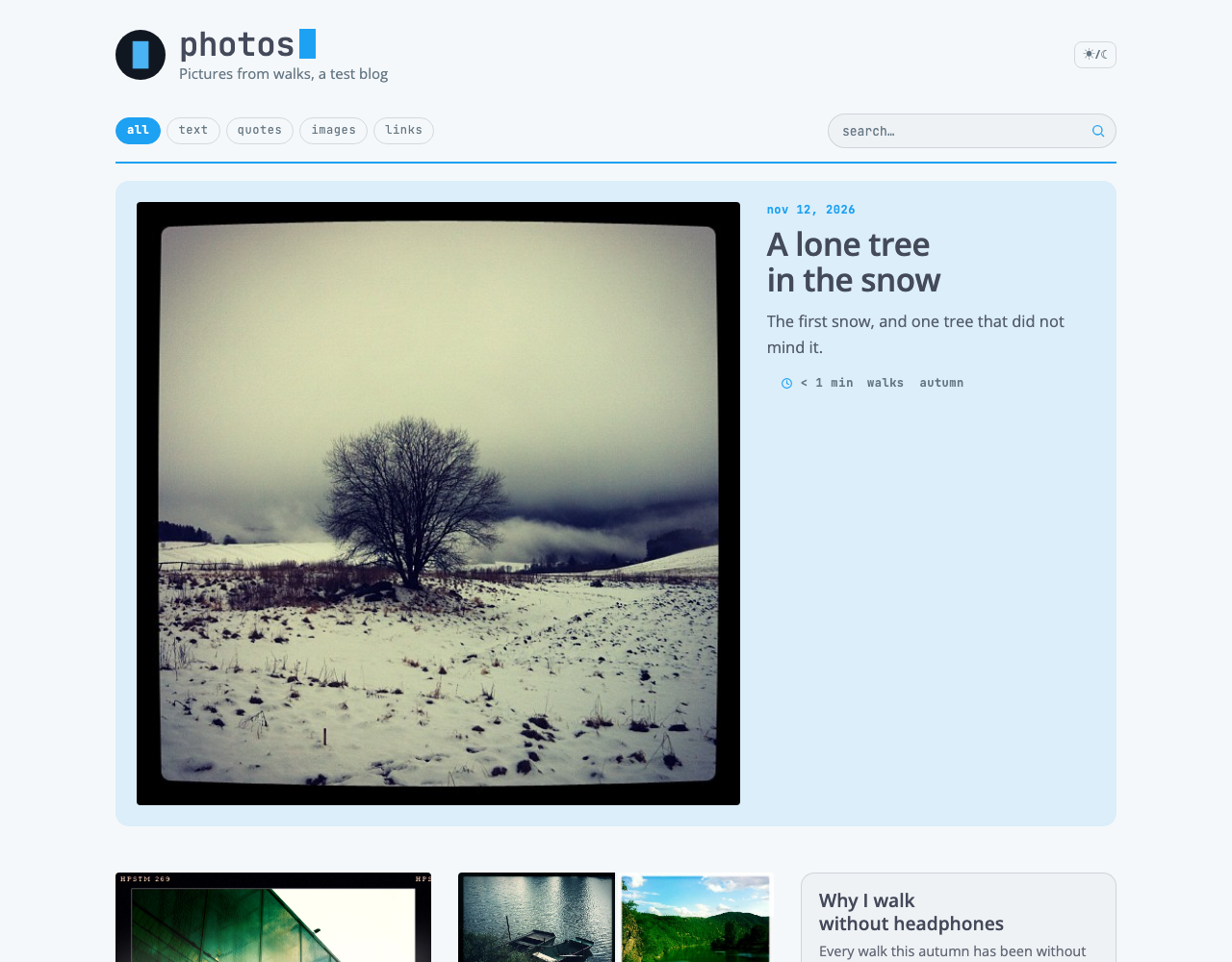
The lead is the first post of the front page and is told by its place, as in Minimal. It stands on the same ground, the accent dissolved in the paper, with a corner of 14 px. It is the one photograph on the wall with something round it, as Minimal's lead is the one row on a card.
- With a photograph it takes a whole row of the wall. The photograph is two cells wide and never taller than it is wide; an upright one is cropped to a square. In the third cell, from the photograph's upper edge, stand the date, the title (24 to 34 px), up to eight lines of text and Minimal's line of facts: "read more", the reading time, the numbers from the network and the tags. If the post has only a title and a few tags, only those stand there, and it is enough.
- Without a photograph it is Minimal's lead, whole and unchanged. Pictorial only gives it its place: two cells of the three and three half rows, so the third column beside it fills with the tiles that follow.
The post
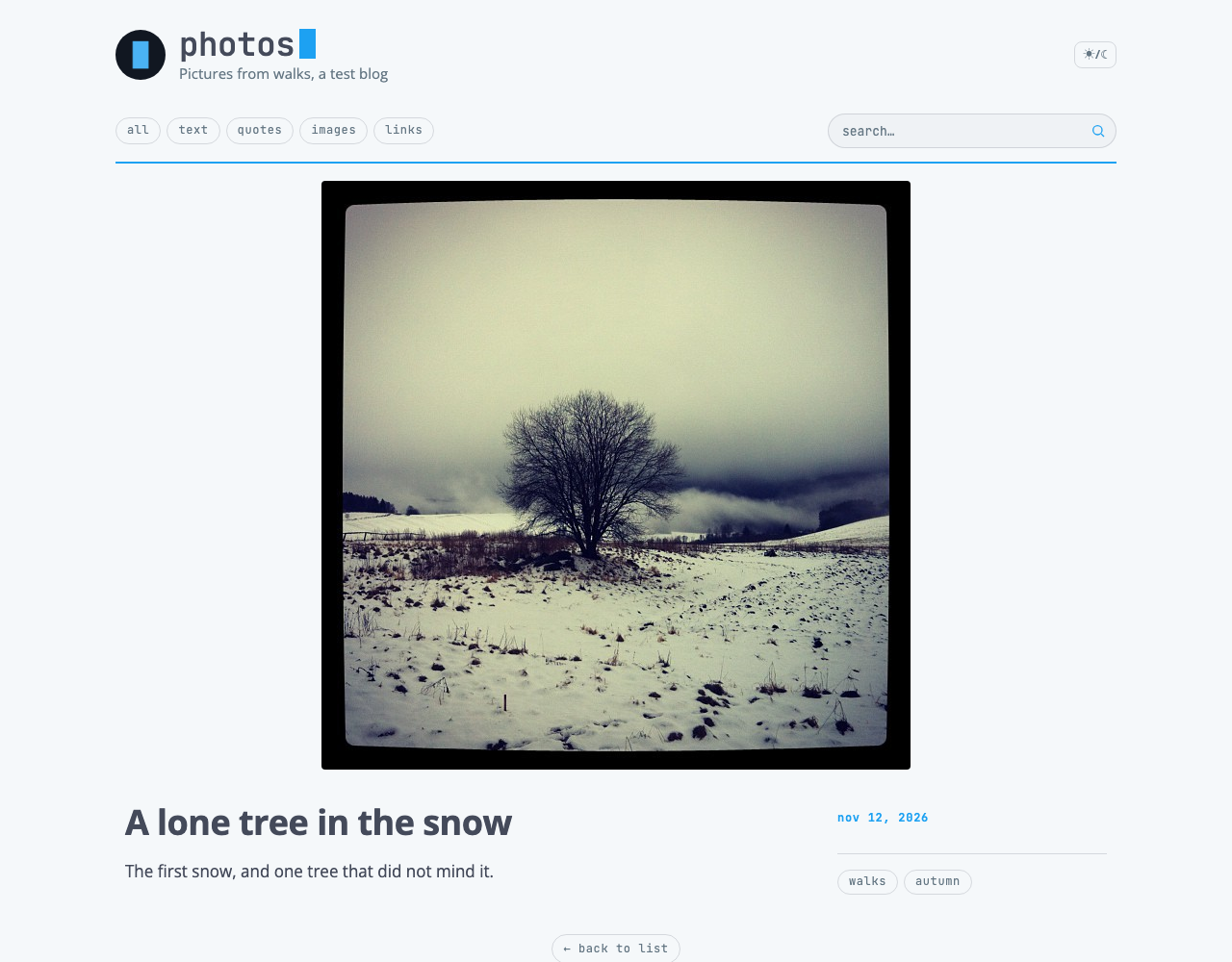
Without a hero, the photograph comes first and as large as the window lets it be: whole, never cropped, at most 86 % of the window's height and no more than 900 px. Under it there are two columns.
- On the left, 700 px: the title, the text, sharing and the comments.
- On the right, 280 px: what the engine knows. The date in the accent, the part of a series, and under a rule the tags as pills.
So a long text has a line it can be read on, and the width of the page is still used. Under 900 px of width there is one column.
A picture leads its post only when it stands at the head of it: first, or after one or two paragraphs. A picture from the middle of a long article stays where the author wrote it. A post with a hero (layout.hero, or hero: on the post) keeps Minimal's page instead: the picture cut to 460 px over one column.
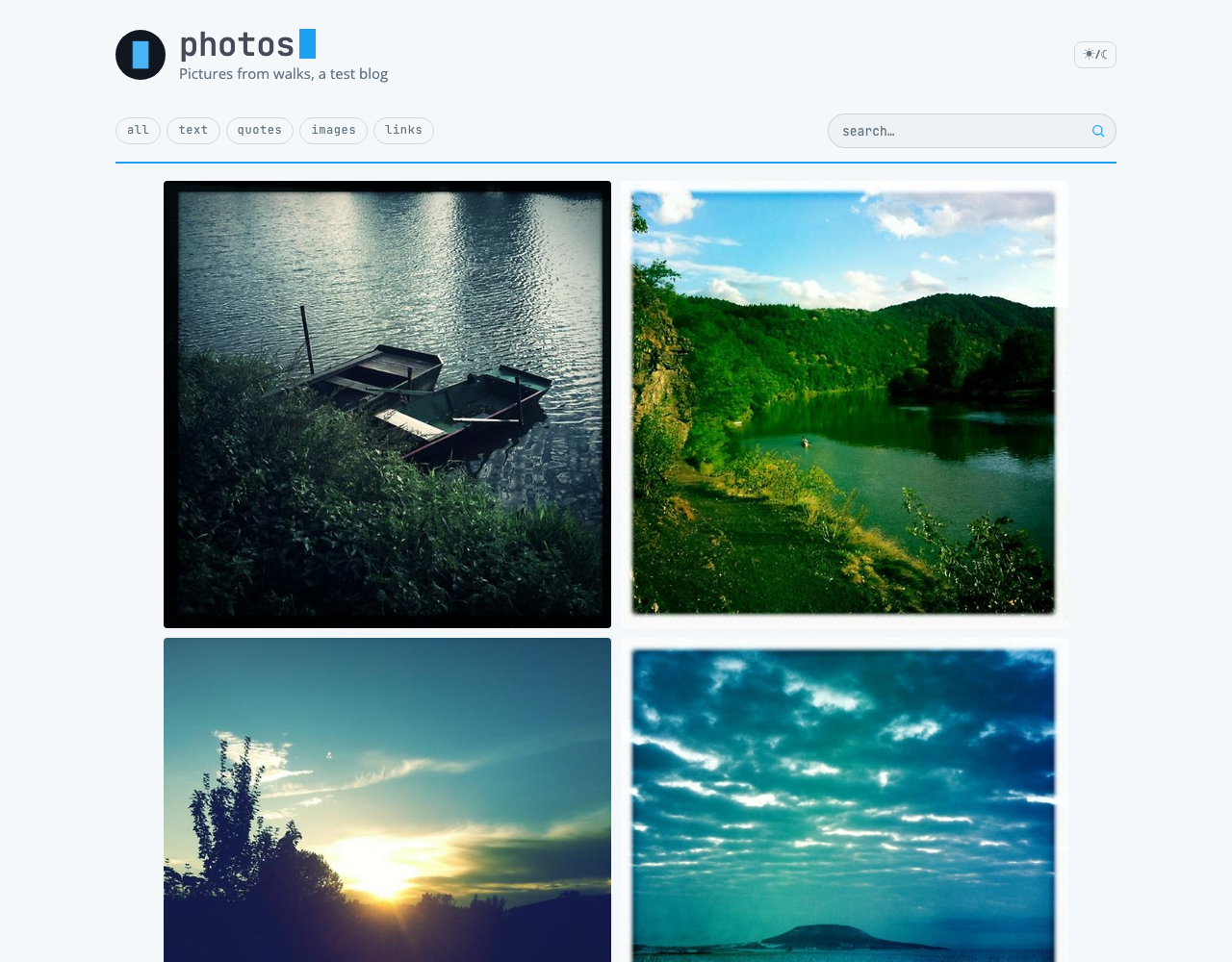
A gallery is a small wall: every photograph whole, in rows from left to right. Three across for five or more photographs, two for fewer; those two are at most 940 px wide, so that two upright photographs still fit a window. The gap is 10 px.
The contents are a block over the text, not a box floating beside it.
The engine's pages
The archive, the list of tags, the list of series, search and the page that is not there are Minimal's, unchanged, only without the sidebar beside them. The archive, the list of tags and the list of series are lists of words and numbers, and there would be no wall to make of them.
The results of a search are rows as in Minimal, with the date on the left, and they are not tiles. Where a post has a picture, its first one stands at the end of the row as a square of 96 px, 72 px on a phone.
State and response
Hovering, focus, the blinking cursor and noughts that are not shown are Minimal's. By night photographs are dimmed to 82 % of their brightness and come back to full under the cursor; it shows more on the wall than anywhere, because there is nothing there but photographs.
A tile's title is underlined in the accent under the cursor. The date, in the accent, turns to the ink.
Phone
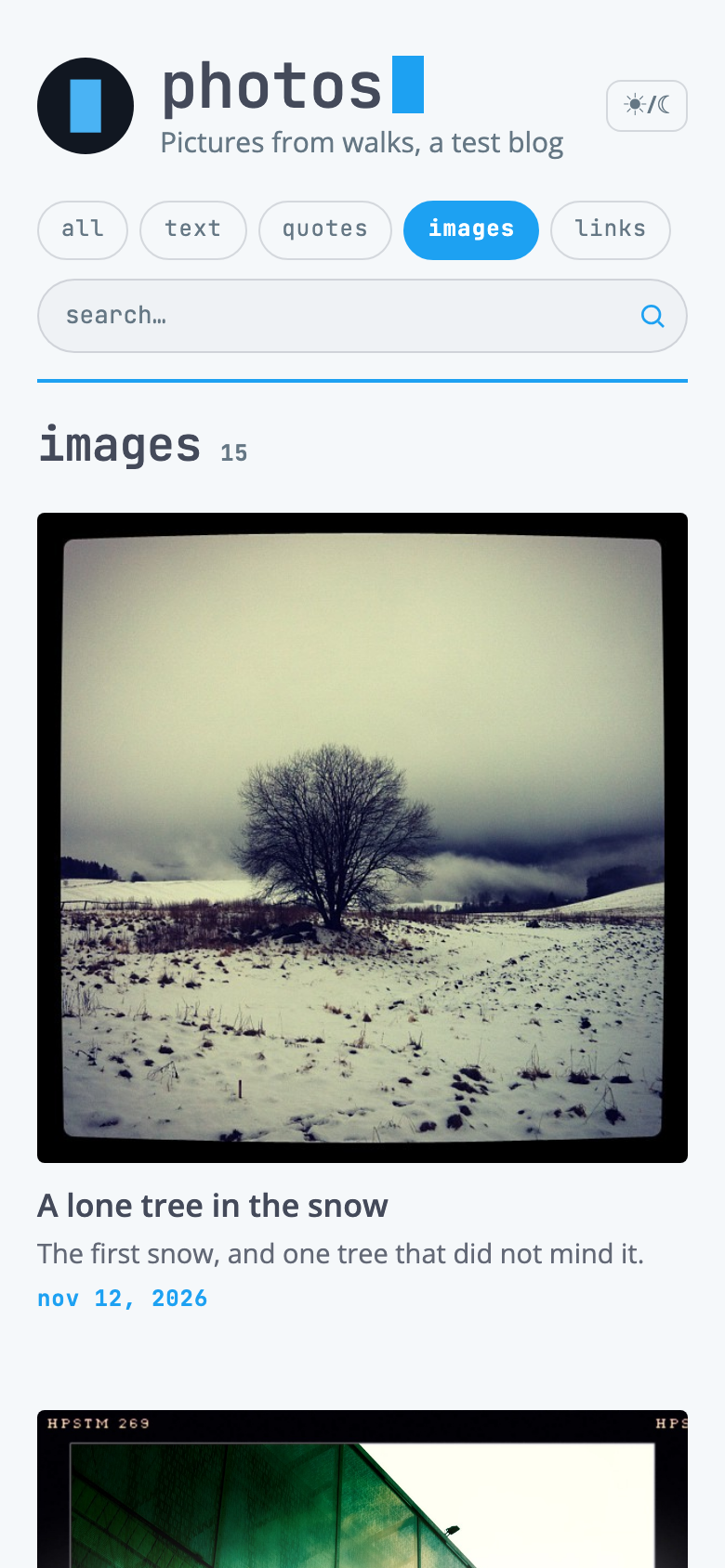
Under 900 px of width the wall has two columns; under 560 px one, with a gap of 36 px. A lead with a photograph has its words under the photograph and reaches ten pixels into the page's margin on each side.
A post's page is one column: the photograph, the date, the title, the text, the tags. A gallery on a phone always has two columns, 6 px apart. The cards under the wall go one under another.
The menu and the site's name behave as in Minimal.
The family
Minimal Pictorial is one of the Minimal family of skins for ./blog.sh, which stands on Minimal, Terminal on classic. The skins share four things: they read their colours from the blog's settings, they are one file, they touch no template, and their guides have these sections in this order (Manual adds one of its own). What Minimal can already do, a variant inherits unchanged; the table says what this one does otherwise.
| Minimal | Minimal Pictorial | |
|---|---|---|
| A listing | open rows with the date on the left | a wall of tiles, three across |
| A picture in a listing | under the title, at most 420 px tall | first, a square across the cell |
| A post with no picture | a row like any other | a tile of words on a card |
| The sidebar | beside the content, 300 px | under the content, three cards across |
| A lead with a photograph | the photograph under the title | the photograph on the left, the words on the right |
| A post's page | a head, the text, pictures in the text | the photograph first, two columns under it |
| A gallery | a grid, with photographs across two cells | rows of whole photographs |
| The date in a post | over the title | in the right-hand column |
Checklist
Ten questions before anything is added to the skin. If any of them comes out no, it is not Minimal Pictorial.
- Is the picture the first thing you see, on a tile and in a post?
- Has a photograph on the wall nothing round it but a corner of 4 px?
- Is a photograph a square on the wall and whole in its post?
- Does a post with no photograph stand on a card, its words at the top and its date at the foot?
- Is there no hole in the wall where words stand beside a photograph?
- Is no tile with tags a photograph and a date alone?
- Is only the lead on a ground, and is it Minimal's ground?
- Has a long text in a post a column it can be read in?
- Are the pages without pictures (the archive, the tags, search) Minimal's and not a wall?
- Does the skin carry only itself: no font, no script, no touching a template?
Changes
13 October 2026: the first edition.
14 October 2026: one name for each thing across the family's guides; links to Minimal's guide and to the family.
16 October 2026: the skin comes with the engine from blog.sh 1.11, put on with site.skin: minimal-pictorial.
15 November 2026: brought up to date with blog.sh 1.11.1. A gallery's tile as a mosaic; a search result with its picture; a link tile's address small and first, a fifth of the line; the hero; the air under a lead; what makes a tile of words, and what its + says. New pictures.
Comments